
More than half of US consumers now routinely end the month short of funds
Credit One Bank reports that over 57% of U.S. consumers regularly end the month short of funds, driven by rising costs
Press Release Disclaimer: This is a press release distributed through the XPR Media network. It has not been independently verified by our newsroom.


DimaBerlin // Shutterstock
For years, a household budget had a little give. A slightly higher electric bill one month could be absorbed by a slightly cheaper grocery run the next. That cushion is gone for most U.S. consumers, and the bills doing the damage are the ones no family can opt out of.
A new survey of 1,000 U.S. consumers from Credit One Bank found that 57% now routinely end the month with less money than expected, with over a quarter saying it happens almost every month and another nearly 3 in 10 (29%) saying it happens more often than not. Coming up short has stopped being an occasional accident. It has become the baseline.
The mood behind that number is stark. More than 8 in 10 (83%) respondents say the cost of living has grown at least somewhat harder to manage over the past two years, leaving only 17% who feel their situation is about the same or better. What follows is a look at which bills are applying the pressure, and what people are changing to keep up.
Key Findings
- 83% of U.S. consumers say managing the cost of living has become at least somewhat harder over the past two years.
- 40% name groceries and household staples as the single biggest strain on their budget, nearly double the share who point to rent or mortgage.
- 57% end the month with less money than expected at least more often than not.
- 79% of Gen Z have delayed or rethought at least one major life milestone because of rising costs.
- 44% say housing costs are either preventing them from saving or are their single biggest financial stressor.
- 45% say financial stress affects their mental health on a daily or regular basis.
- 55% describe their ability to get ahead as either completely impossible or treading water.
The Majority Feel the Financial Squeeze
Credit One Bank
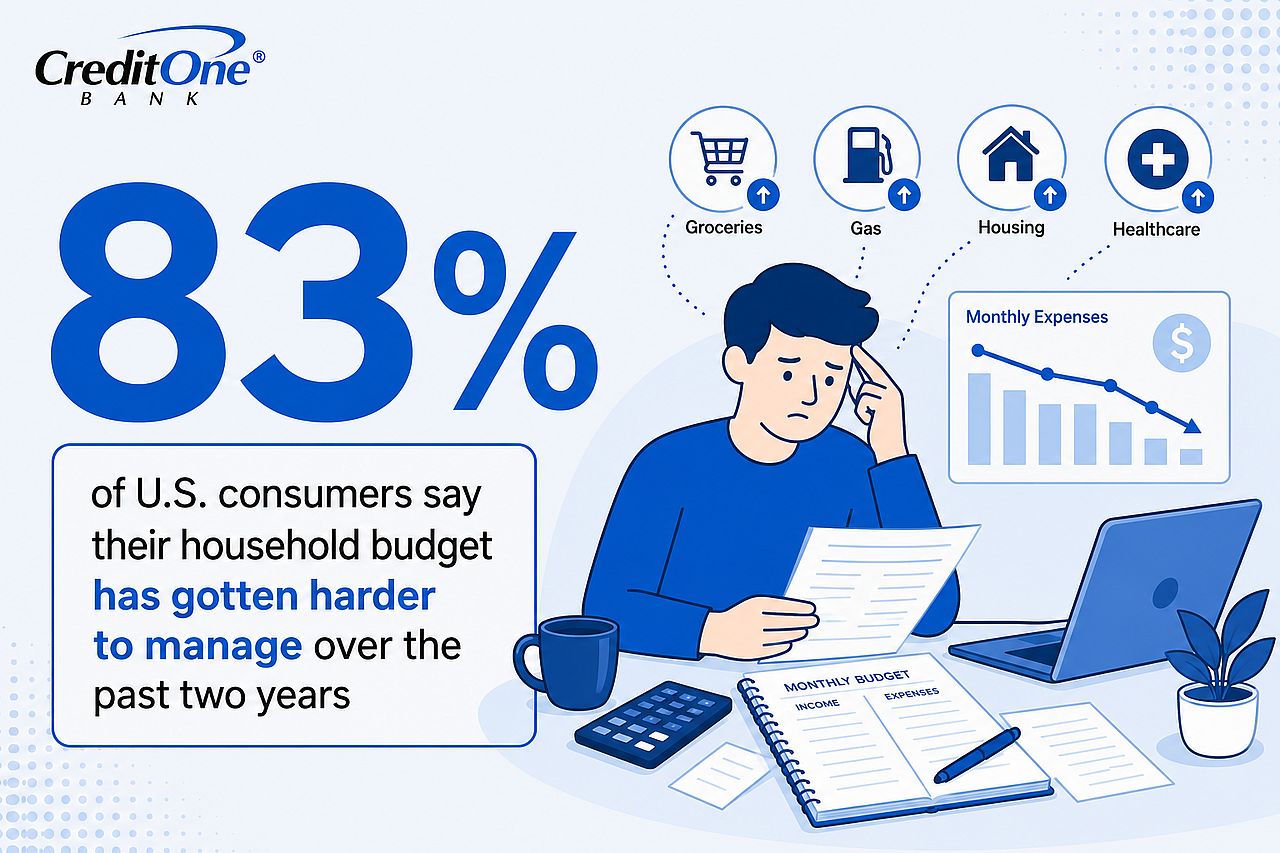
The affordability conversation has been running in headlines and campaign speeches for a while now, but the survey puts a number on how personal it has become. A combined 83% of U.S. consumers say their household budget has gotten harder to manage over the past two years. Within that group, nearly a quarter (23%) say keeping up is now nearly impossible, and another quarter (26%) say things are significantly harder and they are barely managing.
The pressure is not shared evenly. Among households earning less than $25,000, 38% say keeping up is nearly impossible, compared with just 7% of those earning between $100,000 and $249,000. Women report the most severe strain more often than men, with 26.1% choosing “nearly impossible” against 19% of men.
That gap between who feels the squeeze and who absorbs it plays out on the ground. In North Texas, United Way of Metropolitan Dallas reported that local energy costs jumped nearly 19% over the past year, while one in four Dallas County children faces food insecurity, leaving families to weigh feeding their kids against filling the gas tank. The survey suggests those tradeoffs are a national story, not just a regional one.
Groceries Became the Everyday Villain
Credit One Bank
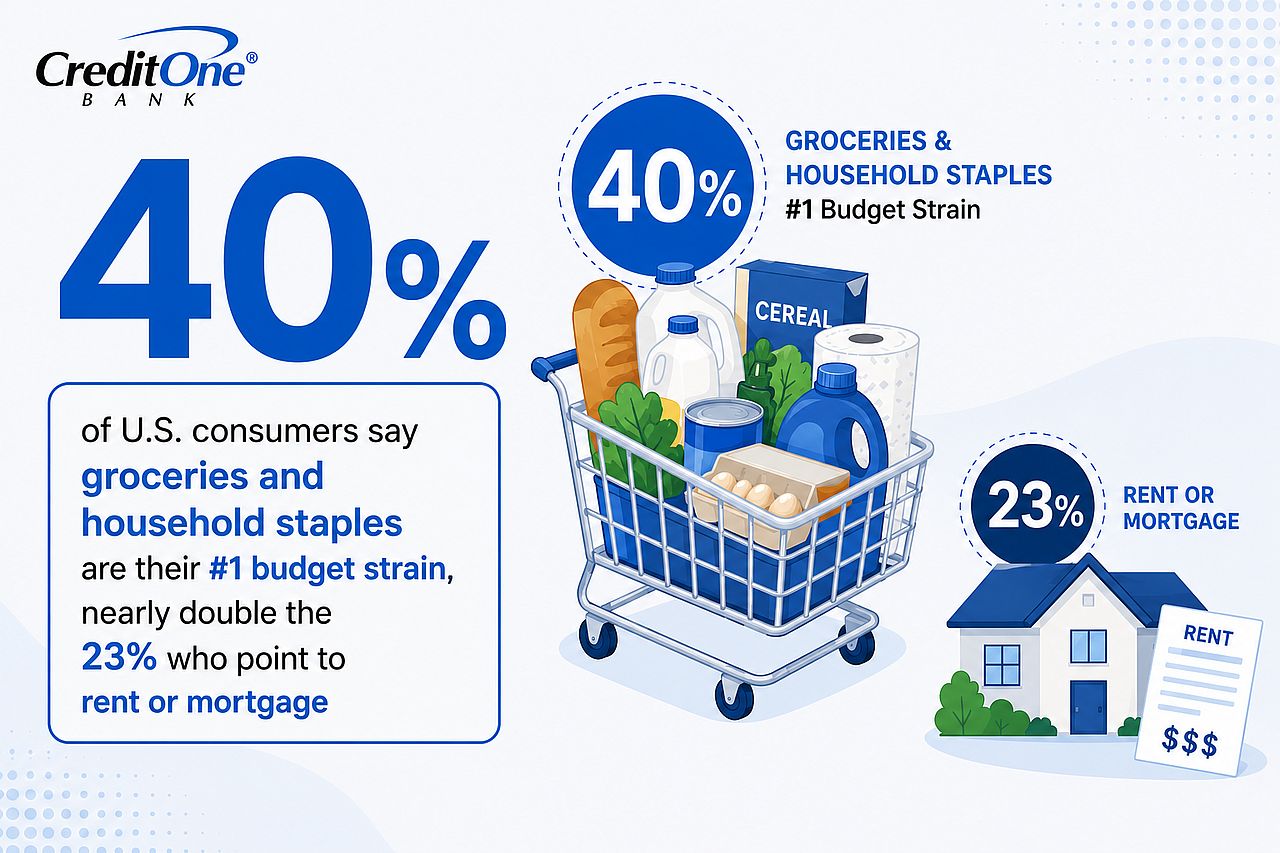
Ask U.S. consumers to name the single cost hitting hardest and the answer is not the mortgage. It is the grocery cart. 40% point to groceries and household staples as their top budget strain, nearly twice the share who name rent or mortgage payments at 23%.
The generational split is sharp. Half of Baby Boomers (50%) name groceries as their biggest pressure, compared with 29% of Gen Z. The youngest adults feel housing more acutely instead, with 29% of Gen Z citing rent or mortgage as their top strain, nearly double the Baby Boomer rate of 16%.
Groceries stand out partly because they are visible and frequent, but the deeper problem is the bills that show up whether anyone is watching or not. On Long Island, the New York Post reported electric bills climbing as much as 20% and water rates rising for a third straight year, with the local power authority pointing to record cold weather and higher fuel costs. One resident described utilities as bills “you have no choice but to pay.” Those are the costs a family cannot coupon its way out of, and they are the ones quietly resetting the baseline.
8 in 10 Gen Z Are Skipping Traditional Milestones
Credit One Bank
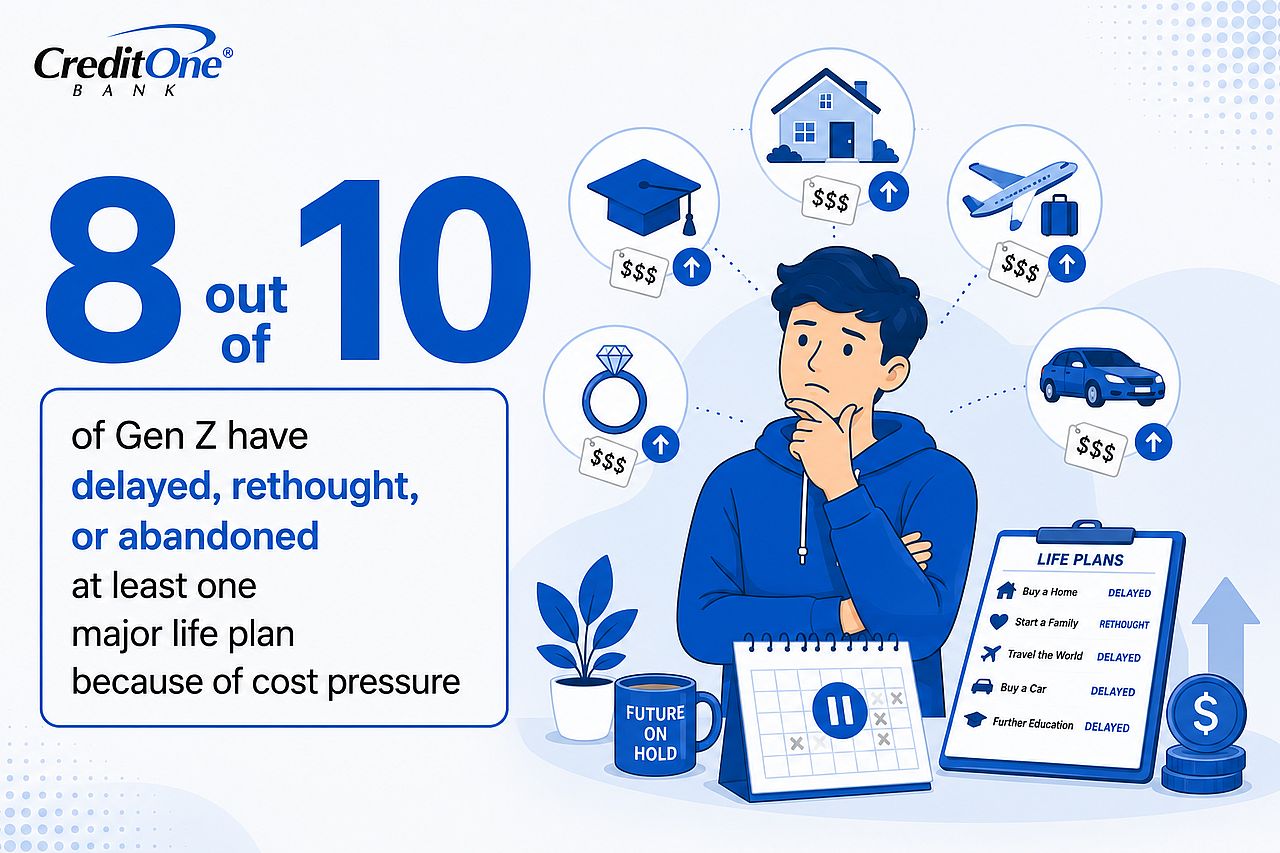
For younger adults, rising costs are not just trimming discretionary spending. They are moving the milestones that used to define adulthood. 79% of Gen Z have delayed, rethought, or abandoned at least one major life plan because of cost pressure. Only 21% say none of their plans have changed, against 59% of Baby Boomers and 54% of Gen X.
The specifics track a generation putting life on hold. The milestones below are not mutually exclusive, so a single respondent could report delaying several at once, which is why the individual figures add up to more than the 79% headline. Among Gen Z:
- 35% have delayed buying a home
- 33% have deferred additional education or job training
- 29% have delayed having a child
- 24% have postponed marriage
- 22% have given up on starting a business
Together these choices describe a cohort recalibrating what it can realistically expect.
Older U.S. consumers are feeling a different version of the same force. Rather than delaying the start of adult life, 27% of Baby Boomers and 24% of Gen X report that rising costs have pushed back their planned retirement date. Younger adults are postponing the milestones that mark the beginning of adulthood, while older adults are postponing the one that marks its next chapter. The same cost pressure is stretching the timeline at both ends.
Housing Is Blocking the Savings Safety Net
Beyond the monthly strain, housing is doing structural damage to the ability to save at all. A combined 44% of U.S. consumers say housing costs are either preventing them from building any savings (23%) or are their single biggest financial stressor (21%).
Gen Z sits at the sharp edge of this. More than a third (36%) say housing costs alone are blocking them from saving anything, the highest share of any generation. Without savings, there is no buffer, which helps explain why the same group is leaning hardest on credit and other coping strategies to stay afloat.
Older homeowners are at an advantage here. Among Baby Boomers, nearly 3 in 10 (30%) say they own their home outright and feel little housing pressure. The result is a widening divide between U.S. consumers who bought before the market tightened and those still trying to get in, with the safety net available mostly to the group that already has one. For households still trying to build that cushion, setting up an emergency fund is often the first step back toward stability.
Tight Budgets Affect Mental and Now Physical Health
Credit One Bank
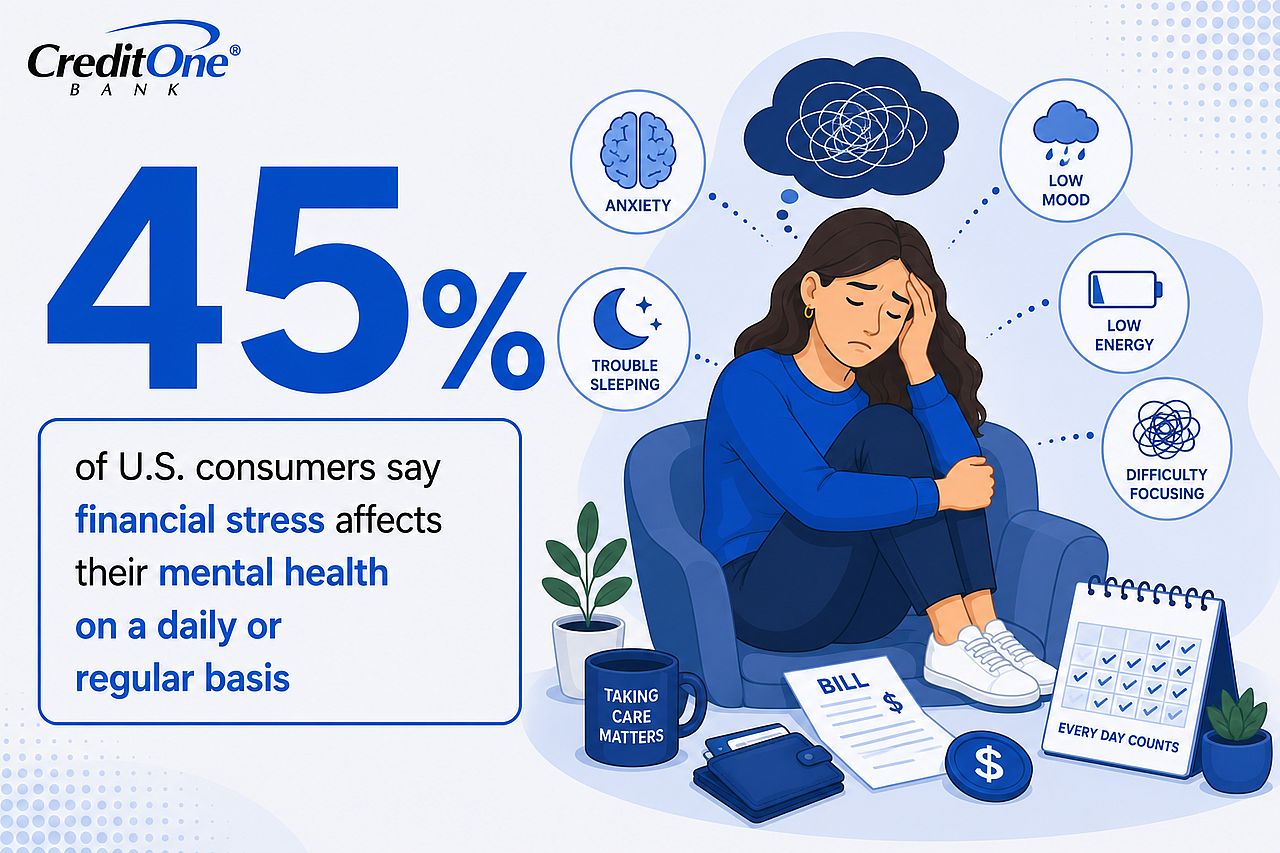
The strain is no longer staying in the budget. It is showing up in people’s health. 45% of U.S. consumers say financial stress affects their mental health on a daily or regular basis, split between 20% who call it a daily struggle and 26% who regularly feel anxious or depressed over money. Only 15.1% say their mental health has not been affected at all.
Women and low-income households carry the heaviest load. Among women, 21% describe a daily mental health struggle, compared with 17% of men. For households earning under $25,000, the daily-struggle rate climbs to 29%, and with regular anxiety added the combined rate for the lowest earners reaches 51%, just over half.
Cost pressure is also pushing people to trade away care. A combined 57% of U.S. consumers have taken at least one cost-driven healthcare action in the past year. Respondents could report more than one, so the actions below overlap rather than sum to that total:
- 28% delayed or avoided a doctor’s visit to save money
- 17% skipped filling a prescription because of the cost
- 17% asked a doctor for a cheaper alternative medication
- 16% chose a lower-cost health insurance plan with worse coverage
- 14% went without health insurance because they could not afford premiums
- 10% rationed or split pills to make a prescription last longer
That behavior lines up with what is happening in local markets. A March 2026 AARP New York survey found older New Yorkers cutting back on prescriptions and medical care to keep up with utility bills, and in Missouri, the Missouri Independent reported that some residents expected to go uninsured in 2026 as enhanced federal subsidies were set to expire. When a fixed bill rises, something has to give, and increasingly, that something is care.
More Than Half Cannot Get Ahead
Underneath the individual pressures sits a broader loss of momentum. 55% of U.S. consumers describe their ability to get ahead as either completely impossible or treading water. 27% say getting ahead feels completely impossible and they are just trying not to fall further behind, while 28% say they are surviving without making real progress. Only 7% feel they are in a better position than they were two years ago.
The gender gap widens here. Among women, 31% say forward progress feels completely impossible, against 20% of men. For households earning under $25,000, 62% land in either the “impossible” or “treading water” category, a reminder that the further down the income ladder a household sits, the more the door to mobility appears shut.
This is where the everyday bills and the big-picture outlook meet. A month that ends short is a setback. A string of them, with no savings forming and no milestone within reach, becomes a sense that the effort itself is not adding up. For many U.S. consumers, getting a budget back on track starts with accounting for exactly where the money goes.
Summary
The story in this data is not really about any single bill. It is about what happens when the unavoidable household costs all increase at once, and the small monthly cushion that used to absorb them disappears. Groceries, utilities, rent, insurance, and healthcare each take a turn, and the combined weight lands hardest on the people with the least room to move.
What stands out is how ordinary the coping has become. Ending the month short, leaning on a credit card for a bill that used to be routine, putting off a wedding or a first home, skipping a doctor’s visit to make the numbers work. None of it reads as dramatic in isolation. Taken together, it describes millions of U.S. consumers quietly reorganizing their lives around costs they did not choose and cannot easily change. The affordability conversation is often framed in aggregates and averages. Behind those numbers are households doing the daily math, and finding that the math keeps getting harder.
Methodology
To understand how U.S. consumers are managing the rising cost of everyday living, Credit One Bank surveyed 1,000 adults across the country. Participants answered questions about how rising costs have affected their household budgets, their use of credit, their savings and coping strategies, their major life plans, their housing and healthcare decisions, and their mental and emotional wellbeing. Responses were analyzed by demographic groups, including age, gender, household income, and education, to identify trends and disparities. Generational labels reflect Gen Z (18–29), Millennials (30–45), Gen X (46–61), and Baby Boomers (62+).
This story was produced by Credit One Bank and reviewed and distributed by Stacker.


