
Zenwork Launches GovPay.ai to Close the Tax Payment Gap for Enterprises, Payroll Providers and AI-First Tax Platforms
With $40.3 billion in IRS penalties assessed in FY2024 for late or missed payments and deposits, GovPay.ai gives
Press Release Disclaimer: This is a press release distributed through the XPR Media network. It has not been independently verified by our newsroom.
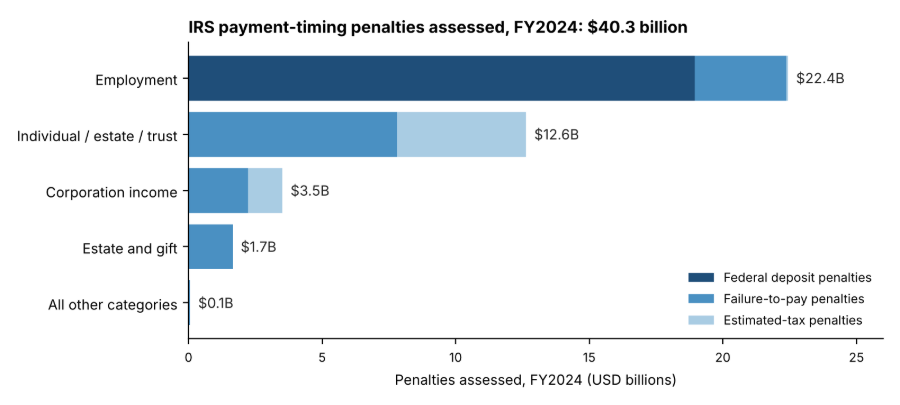

With $40.3 billion in IRS penalties assessed in FY2024 for late or missed payments and deposits, GovPay.ai gives software providers, payroll companies, accounting firms and enterprise finance teams one infrastructure layer to execute, authorize, track and reconcile federal and state tax payments. Capabilities are also integrated into Tax1099.
FAYETTEVILLE, AR AND DALLAS, TX / ACCESS Newswire / October 22, 2026 / Zenwork, a leading provider of tax and regulatory compliance solutions, today announced the launch of GovPay.ai, a tax payment platform that connects federal and state tax payments to the compliance workflows businesses already run. GovPay.ai is built for organizations that move tax money at volume: large enterprises operating across many jurisdictions, payroll companies and PEOs remitting on behalf of thousands of employers, AI-first tax filing platforms that want to finish the job they start, and the tax software providers and accounting firms that serve them.
The launch also brings supported tax payment capabilities into Tax1099, Zenwork’s established tax compliance platform, so customers can manage filing and payment in the same environment.
The cost of getting payment wrong: what the IRS data shows
Filing has gone digital. But paying often has not, and the penalty data shows where that gap hurts. According to the IRS Data Book 2024 (Table 28), the IRS assessed $84.1 billion in civil penalties in fiscal year 2024. Of that, $40.3 billion, or roughly 48%, came from three penalty types tied directly to the timing of payments rather than to filing: failure to pay, failure to make federal tax deposits, and underpayment of estimated tax.
|
Tax category |
Failure to pay |
Federal deposits |
Estimated tax |
Payment-timing subtotal |
|
Employment |
$3.43B |
$18.94B |
$0.07B |
$22.44B |
|
Individual / estate / trust income |
$7.82B |
– |
$4.82B |
$12.64B |
|
Corporation income |
$2.23B |
– |
$1.29B |
$3.52B |
|
Estate and gift |
$1.65B |
– |
– |
$1.65B |
|
Excise / exempt organizations |
$0.05B |
$0.004B |
$0.005B |
$0.06B |
|
Partnership and S corporation |
$0.004B |
– |
$0.002B |
$0.005B |
|
Total |
$15.19B |
$18.95B |
$6.18B |
$40.32B |
Source: IRS Data Book 2024, Table 28 (FY2024: October 1, 2023 – September 30, 2024). Figures are penalties assessed, not cash collected, and span multiple tax years. Late-filing penalties are excluded from the payment-timing subtotal.
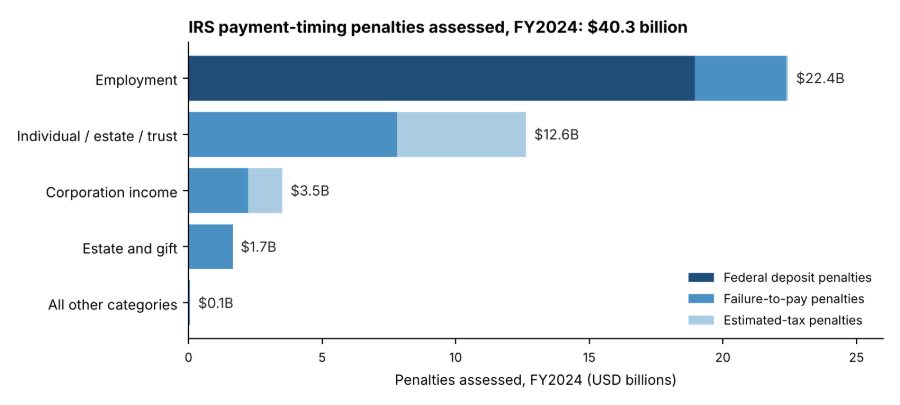
Chart: FY2024 IRS payment-timing penalties assessed, by tax category. Source: IRS Data Book 2024, Table 28.
Three points stand out for the organizations GovPay.ai is built to serve:
- Employment taxes are the epicenter. Employment tax accounts generated $22.4 billion in payment-timing penalties, more than half of the total. Federal deposit penalties alone were $18.9 billion; about 70% of all civil penalties assessed on employment taxes. These figures highlight the importance of timely and accurate employment-tax deposits for payroll providers and employers managing obligations across multiple entities.
- Estimated payments are a recurring trap. Individuals, estates, trusts, and corporations were assessed $6.2 billion for underpaying estimated tax, an obligation that recurs every quarter and is exactly the kind of payment that is easy to miss when it lives outside the filing workflow.
- Abatement is not a strategy. The IRS abated $75.2 billion in civil penalties in the same year. Abatements and assessments come from different cohorts and cannot be netted, but the scale shows how much time taxpayers and their advisors spend contesting penalties after the fact, time a reliable payment process avoids.
The state picture is just as costly, and harder to see
There is no single national figure for state tax penalties and interest. States report on different bases, cover different taxes, and often split withholding and unemployment insurance across separate agencies. The figures that are published, though, show the cost is material:
|
State |
Penalties and interest |
Basis |
Coverage |
|
Michigan |
$329.4M |
FY ended 9/30/24; accrual revenue |
Governmental tax penalties and interest |
|
Washington |
$179.3M |
FY ended 6/30/24; collections |
Revenue Act taxes only |
|
Connecticut |
$141.2M |
FY ended 6/30/24; receipts |
DRS taxes ($47.1M penalty; $94.1M interest) |
|
Alaska |
$3.2M |
FY ended 6/30/24; collections |
Corporate income tax only |
Sources: Michigan FY2024 ACFR; Washington DOR collections Table 4; Connecticut DRS FY2025 Annual Report; Alaska Tax Division Annual Report 2024. Figures are not comparable across states and should not be summed. Other states were not verified for this release.
Interest compounds the damage. In Connecticut, interest receipts were roughly twice penalty receipts. A payment that slips by weeks can cost more in interest than in the original penalty.
Why paying is still the hardest step: 50 states, 50 portals, one deadline
Most tax software stops at the return. The payment still has to be made on a government system, and each system works differently. For a team paying taxes for one entity in one state, that is an inconvenience. For an enterprise, payroll provider or tax platform paying for hundreds or thousands of taxpayers, it becomes an operations problem:
- Separate accounts for every agency and every tax. Employers typically need a withholding account and a separate unemployment insurance account in each state, each with its own login, forms, and submission process. Some states, including California, New York and New Jersey, add separate programs for disability or paid family leave. An employer with staff in 20 states can be managing 40 or more agency accounts before counting sales tax.
- Different authentication everywhere. State portals use their own sign-in methods: email verification in one, security questions in another, state-specific multi-factor authentication in a third. Credentials, MFA devices, and password resets have to be tracked for every portal and every person who touches it.
- Enrollment that runs on mail and fax. After IRS validation, new EFTPS enrollees receive a PIN by U.S. mail in five to seven business days. This enrollment process can delay access to the payment system. In California, third-party payers enrolling in the EDD’s State Data Collector Program submit Form DE 26 by fax or mail, then wait for a letter with a temporary security code.
- Representative access is its own workflow. Payroll agents and representatives often need their own credentials plus a separate authorization step for each client account they pay on behalf of.
- Unforgiving cutoffs. EFTPS payments should be scheduled by 8 p.m. Eastern the day before the due date. California EDD applies a 15% penalty plus interest when an EFT payroll tax payment does not settle on time.
- Reconciliation by hand. Confirmation numbers, receipts and payment statuses sit in each portal. Finance teams often copy them into spreadsheets to prove what was paid, when and for whom.
Every manual login, re-keyed amount and copied confirmation number is a chance for a payment to be late, misapplied or missing. That is the gap GovPay.ai is designed to close.
What GovPay.ai processes
GovPay.ai supports federal tax payments nationwide and state tax payments across all 50 states and the District of Columbia, using the applicable tax period and jurisdiction-specific tax account information. Local tax payments are on the roadmap.
|
Payment type |
Typical use |
|
Estimated tax payments |
Quarterly federal and state estimates for individuals, trusts and businesses |
|
Balance-due and extension payments |
Amounts owed with a return, or paid with an extension request to limit failure-to-pay penalties and interest |
|
Payroll tax due payments |
Federal and state payroll tax amounts due from employers, payroll companies and PEOs |
|
Notice payments |
Paying balances due on federal and state agency notices, including assessed penalties and interest |
|
Withholding payments |
State income tax withholding remitted by employers and payroll providers |
|
Sales tax payments |
State sales and use tax remittances for multi-state sellers |
Coverage: Federal (nationwide); State (all 50 states and D.C.); Local (coming soon). Availability of specific payment types varies by jurisdiction.
Every payment moves through the same governed lifecycle: prepare, approve, submit, track and prove. Status is visible at each stage (drafted, scheduled, submitted, rejected or paid), and each payment carries its approvals and receipts for audit and reconciliation.
Key capabilities
- Federal and state tax payments: Manage supported payments using applicable tax period and jurisdiction-specific account information, without logging in to each agency portal.
- Embedded payment infrastructure: Add tax payment functionality to existing software through the GovPay API or a branded GovPay Embedded experience, without building and maintaining each agency connection.
- Repeat and recurring payments: Use saved information for eligible future payments and manage supported recurring payment activity, such as quarterly estimates and periodic withholding.
- Payment authorization and tracking: Review payment details before submission, monitor status, and keep historical records with approvals and receipts for reconciliation.
- Multi-client and multi-entity management: A portfolio view across clients, businesses, and legal entities, with flags for payments that need attention.
- Security: GovPay.ai is SOC 2 Type II compliant.
Built for organizations that pay taxes at scale
Large enterprises and multi-entity finance teams
Enterprises with legal entities and employees across many states face the same payment steps on dozens of portals every period. GovPay.ai gives treasury and tax teams one place to prepare, approve and track payments across entities and jurisdictions, with an approval trail and receipts that support internal controls and audit requests.
Payroll companies and PEOs
With federal deposit penalties alone reaching $18.9 billion in FY2024, the timing of employment-tax remittances is a core risk for anyone running payroll for others. Payroll providers can use the GovPay API to manage supported payroll tax, withholding and notice payments across federal and state agencies, track each payment’s status, and keep a per-client record of what was paid, instead of maintaining separate agency logins and representative authorizations for every client and state.
AI-first tax filing platforms
A new generation of AI-native tax platforms can prepare and file a return in minutes, then send the user to a government website to pay. GovPay Embedded lets these platforms complete the last step inside their own product, so estimated, balance-due, and extension payments happen in the same flow as the return. Structured payment statuses and records also give automated workflows clear data to act on, rather than screenshots of a portal confirmation page.
Tax software providers and accounting firms
Software providers can offer payments without building agency-by-agency integrations. Accounting firms managing hundreds of clients can use the GovPay Platform workspace to coordinate client payments, approvals and confirmations in one place.
Three ways to deploy
|
Option |
Best for |
|
GovPay API |
Payroll companies, enterprises and platforms that want to integrate tax payment execution into their own systems |
|
GovPay Embedded |
Tax filing and financial software providers that want a branded payment experience inside their product |
|
GovPay Platform |
Accounting firms and finance teams that want a ready-made workspace to manage client and entity payments |
GovPay.ai integrated into Tax1099
Alongside the launch, Zenwork has integrated its tax payment capabilities directly into Tax1099. Existing Tax1099 customers can use eligible account information already in the platform to prepare payments, review details before authorization, and monitor payment activity from a single dashboard. Firms managing many clients, and businesses with recurring obligations, can now coordinate filing and payment in the same platform.
“For years, businesses have invested in digitizing tax preparation and filing, yet tax payments often remain disconnected from those workflows,” said Sanjeev Singh, Founder of Zenwork. “With GovPay.ai, we are addressing the gap. Our vision is to make tax compliance more connected, while giving software providers the infrastructure to bring these capabilities directly to their customers.”
Looking ahead
Zenwork plans to expand GovPay.ai beyond federal and state payments to local tax payments, so businesses, payroll providers and accounting firms can manage more of their tax payment responsibilities on one platform. Organizations interested in the API, Embedded or Platform options can request a demo at govpay.ai.
About Zenwork Inc.
Zenwork Inc., the parent company of Tax1099 and backed by Spectrum Equity, is a key player in digital tax compliance and regulatory reporting technology. With a decade of experience, Zenwork has helped more than 1 million businesses and 30,000 CPA firms simplify compliance.
Learn more at www.zenwork.com, www.tax1099.com, www.compliancely.com and www.govpay.ai.
Contact: Ed Pratt, Zenwork Inc., ed@zenwork.com
SOURCE: ZENWORK INC
View the original press release on ACCESS Newswire
