
HealthHQ Discusses Progressive Loading and Capacity Versus Demand for Winter Training Physical Therapy
FENTON, MI - October 29, 2026 - PRESSADVANTAGE - As Michigan moves deeper into late fall, colder temperatures and
Press Release Disclaimer: This is a press release distributed through the XPR Media network. It has not been independently verified by our newsroom.

FENTON, MI – October 29, 2026 – PRESSADVANTAGE –
As Michigan moves deeper into late fall, colder temperatures and shorter daylight hours can prompt some residents to adjust their exercise routines. Certain individuals may reduce outdoor activity, while others shift more of their training indoors to gyms or structured programs such as CrossFit. These seasonal activity changes can alter the relationship between an individual’s current physical capacity and the demands of their training, making progressive loading, movement quality, and recovery relevant considerations when adapting routines.
Reduced outdoor movement and a transition to indoor training represent distinct situations. A period of lower overall activity may leave someone with different conditioning than they had earlier in the year. Moving training indoors can introduce different movement patterns, higher session frequency, or changes in volume and intensity. In either case, the demands placed on the body may no longer match recent activity levels. Discussions of winter training physical therapy often center on this capacity-versus-demand relationship rather than on any single exercise format.
Physical capacity depends on factors that include recent activity levels, training history, current conditioning, exercise volume and intensity, training frequency, movement demands, and recovery. When someone returns to a previous workload after reduced activity, or begins a different indoor routine, the gap between what the body is currently prepared to tolerate and what the new routine asks of it can widen. This does not mean that every change produces problems, but it does mean that an abrupt return to prior volume or intensity may not align with present capabilities.
Dr. Mitch Babcock, Founder of HealthHQ, noted that seasonal shifts in exercise routines make the match between current capacity and training demands especially relevant. “When activity patterns change, whether through less outdoor movement or a move to indoor training, progressive loading gives a practical way to adjust volume, intensity, and frequency over time rather than immediately reproducing a previous workload,” Babcock said. “Movement quality also matters when evaluating whether an individual is prepared for particular exercises that appear more often in gym or CrossFit settings.”
Progressive loading provides one framework for aligning training demands with present physical capacity. Gradual adjustments to volume, intensity, frequency, and movement complexity allow conditioning to develop alongside the routine rather than assuming prior levels remain appropriate. This principle applies equally to someone who has been less active outdoors and to someone who has increased the frequency of indoor sessions. It does not eliminate risk, but it offers a measured approach to transitions that accompany Michigan winter conditions.
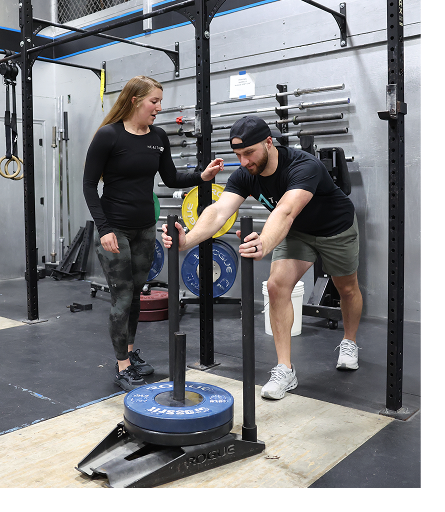
Indoor training environments can place different demands on the body than outdoor activity. Weightlifting, gym-based sessions, and CrossFit winter training often emphasize movements under load, higher training density, or repeated skill practice. Movement quality becomes one factor in determining whether an individual’s current capabilities match those demands. HealthHQ clinicians, several of whom are CrossFit coaches with experience in Olympic weightlifting and functional fitness, integrate this perspective into one-on-one physical therapy. The clinic’s fitness-forward model combines Doctor of Physical Therapy care with coaching and training knowledge, allowing discussions of both rehabilitation and training load when routines change.
Recovery, sleep, and stress further influence physical capacity. Training does not occur in isolation from daily life. Inadequate recovery or elevated stress can reduce the amount of load an individual is prepared to tolerate, even when the exercise program itself has not changed. These factors support the broader capacity-versus-demand discussion without replacing the focus on seasonal activity changes.
Dr. Mitch Babcock added that the clinic’s combination of physical therapy and training experience informs conversations about adapting exercise routines. “Understanding both the clinical side of musculoskeletal resilience and the practical side of CrossFit and gym training helps frame why progressive adjustments and attention to movement quality can be useful when seasonal activity changes occur,” Babcock said.
Considering current physical capacity when modifying exercise routines remains relevant as winter progresses. Neither reduced outdoor activity nor a shift to indoor training automatically increases injury rates, and no single adjustment guarantees prevention of problems. The relationship between training demands and physical capacity simply warrants attention when routines change with the season.
HealthHQ, located in Fenton, provides one-on-one physical therapy with Doctors of Physical Therapy who maintain continuity of care from evaluation through treatment. The practice emphasizes a fitness-forward approach in which clinicians hold CrossFit coaching credentials and advanced training relevant to sports-specific rehabilitation, including for CrossFit and Olympic weightlifting. Care addresses musculoskeletal issues while considering movement, recovery, and overall function for individuals in the Fenton area and surrounding communities.
###
For more information about Health HQ Physical Therapy, contact the company here:
Health HQ Physical Therapy
Dr. Mitch Babcock
810-354-5380
info@healthhq.fit
14261 Torrey Rd. STE C
Fenton, MI 48430
